
CASE
“How Does Gender Inequality Impact on Interstate Disputes and Occurrences of Crises?”
- Dissertation at UCL
WHY
There have been studies to find causes for the outbreak of interstate conflicts and they are found to be the regime type, alliances, contiguity, and economic development – however, the impact of gender inequality has been neglected despite its importance in causing the likelihood of interstate conflicts. Some studies have insisted that states who are characterized by high level of gender equality are less likely to get involved with interstate disputes or respond in a more violent way. Thus, I wanted to further investigate the relationship between gender inequality and the onset of Militarized Interstate Disputes (MIDs) & Severity of International states.
METHODOLOGY
- Collecting dataset from International organizations (World Bank, COW)
- Exploratory data analysis
- Cleaning & wrangling data
- Model & Prediction
- Evaluation
HYPOTHESES
Dependent variables:
- Onset of Disputes
- Severity of violence
Independent variables:
- Social equality (Fertility rate)
- Economic equality (the percentage of women in the labour force)
- Political equality (the percent of women in parliament)
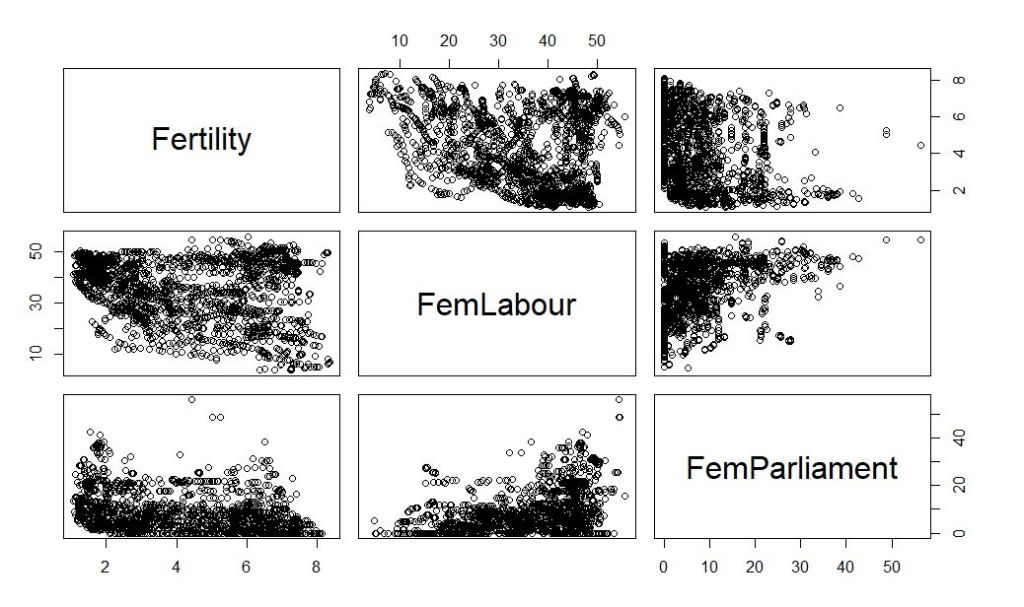
Correlations between indepedent variables are found below.
It is observed that Fertility rate and Female proportion in the labour force is not strongly correlated. Neither is Fertility rate and Female proportion in parliament. However, Female proportion in the labour force and parliament is somewhat positively correlated.
Control variables:
- GDP per capita, GDP growth rate, and the CINC score
- the polity score and The number of alliances
- Direct contiguity (the total number of countries that are proximate in distance)
Null Hypothesis (H0): There is no relationship between the level of gender equality and the probability and violence level of interstate disputes.
H1: The lower the fertility rate is, the less likely that a country experiences the onset of disputes
H2: The higher the proportion of female in the labour force is, the less likely that a country experiences the onset of disputes
H3: The higher the proportion of women in parliament is, the less likely that a country experiences the onset of disputes
H4: The lower the fertility rate is, the lower level of violence a country employs during crises
H5: The higher the proportion of female in the labour force is, the lower level of violence a country employs during crises
H6: The higher the proportion of women in parliament is, the lower level of violence a country employs during crises
MODEL & PREDICTION
I carried out bivariate logistic regression and multivariate logistic regression in order to estimate the impact of gender inequality on the likelihood of international crises and severity of violence.
This is the code written in R Studio:
model1_1 <- glm(Mid1 ~ Fertility +
                  LogGDPpc + GDPGrowth + CINC +
                 Polity + Alliances + Contiguous,
              family = binomial(link = "logit"),
              #Hess=TRUE,
               data = Data8d)
model1_2 <- glm(Mid1 ~ FemLabour +
                 LogGDPpc + GDPGrowth + CINC +
                 Polity + Alliances + Contiguous,
              family = binomial(link = "logit"),
              #Hess=TRUE,
               data = Data8d)
model1_3 <- glm(Mid1 ~ FemParliament +
                 LogGDPpc + GDPGrowth + CINC +
                 Polity + Alliances + Contiguous,
              family = binomial(link = "logit"),
              #Hess=TRUE,
               data = Data8d)
model1_4 <- glm(Mid1 ~ Fertility + FemLabour + FemParliament +
                 LogGDPpc + GDPGrowth + CINC +
                 Polity + Alliances + Contiguous,
              family = binomial(link = "logit"),
              #Hess=TRUE,
               data = Data8d)

screenreg(list(model1_4, model1_1, model1_2, model1_3),
          custom.model.names = c("Model 1", "Model 2", "Model 3", "Model 4"),
          custom.coef.names = c('Intercept', 'Fertility rate', 'Female proportion in the labour force', 'Female proportion in parliament', 'Log of GDP per capita', 'GDP growth rate', 'CINC score', 'Polity score', 'Number of Alliances', 'Number of contiguous countries'))
RESULT & CONCLUSION
As a result of logistic regression analysis, it corresponds to anticipated and earlier arguments. The significance of gender equality is reconfirmed. This analysis has demonstrated that gender equality and the likelihood of disputes and intensity of crises are associated with modern datasets.
Although higher fertility rate is associated with lower likelihood of disputes, but it plays a constraint role in using more severe violence during crises and more hostile action during disputes. Higher proportion of women in the labour force is associated with lower likelihood of disputes and less violent crises. However, higher proportion of female in the political office is not associated with lower probability of disputes, less hostile disputes nor less severe violence during crises.
💼 Looking for a data analyst?
I specialise in turning raw data into actionable insights using SQL, Python, and Power BI.
 Hyesoo Park - Freelance Data Analyst & Automation Specialist